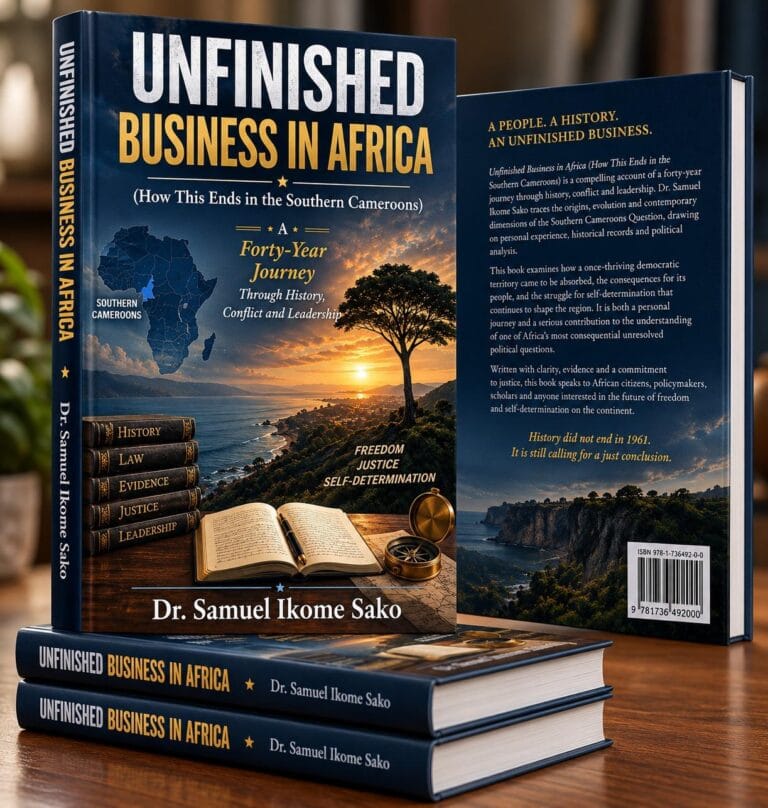
In 1985, a nineteen-year-old Samuel Ikome Sako encountered an argument about the Southern Cameroons that disturbed what he thought he knew about the country in which he had grown up.
He began asking questions.
Those questions followed him through journalism, ministry, humanitarian work, life in the diaspora, political advocacy and, eventually, the presidency of the Southern Cameroons Interim Government during one of the most consequential periods of the modern conflict.
Unfinished Business in Africa is the record of that forty-year journey.
It examines the 1961 United Nations-supervised plebiscite, the constitutional relationship that followed, the abolition of the federal structure in 1972, the re-emergence of the Southern Cameroons Question, the political crisis that began in 2016, the descent into armed conflict, the rise of competing liberation structures, international diplomacy, internal leadership disputes and the difficult question that remains after decades of argument:
How does this end?
This is not written as the final verdict on Southern Cameroons history. Sako writes as both researcher and participant. Where he was present, he gives testimony. Where events preceded him, he returns to documents. Where the evidence is contested, he attempts to preserve the distinction between fact, interpretation, allegation and political conviction.
The result is at once memoir, political history and an invitation to further investigation.
Why This Book Belongs in the Archives
The Sako Leadership Archives exists partly to prevent participant history from disappearing when the participants are gone.
Unfinished Business in Africa contributes one man’s record to that larger historical repository. It preserves what Samuel Sako saw, what he believed, what he did, what he learned, and how his understanding of the Southern Cameroons Question evolved over four decades.
But the book also makes an unusual demand of its own author: the documents should speak, other participants should speak, critics should speak, and researchers should examine all of them.
That principle belongs at the heart of a serious archive.
Who Should Read It?
This book is particularly relevant to Southern Cameroonians and Cameroonians seeking a deeper understanding of the conflict; younger generations inheriting its consequences; African students and scholars of decolonization; historians and constitutional researchers; journalists; diplomats and mediators; political and community leaders; members of the African diaspora; and students of liberation movements, self-determination, conflict resolution and institution building.
It should also be read by people who disagree with Samuel Sako.
An archive becomes valuable when it preserves material capable of being examined, challenged and compared—not merely material with which its founder agrees.
The Larger Question
The final concern of Unfinished Business in Africa reaches beyond the political status of Southern Cameroons.
What kind of institutions should emerge from liberation? How should a society deal with the injuries accumulated during conflict? How can political movements prevent personalities from becoming substitutes for institutions? What responsibility does leadership owe to civilians? How does a people preserve truth when every side has a political narrative?
And what must this generation build so that another generation does not inherit the same unresolved conflict?